
Bonnie Koo

As a female physician, I am challenging you to think beyond your clinical income for ways to grow your wealth. In previous episodes, we’ve discussed everything from investing to side hustles. Those income streams are critical, but it can take time to see a significant generation of wealth, especially from the stock market. That’s why it is so important to understand how real estate investing can help you uplevel your life and your money faster than you might imagine.
In the first episode of our Introduction to Real Estate series, we laid the foundation for real estate investing. Plus, I shared my first toe dip into real estate investing. Now, let’s take a deeper dive into what real estate investing looks like and the myriad options you have even if you’ve already decided that being a landlord isn’t for you.
There are two types of real estate investing--equity and debt. Most people are familiar with equity investing. That is when you own the actual real estate, at least to some degree. Most people think of a single family home rental property. That certainly is one example. Other instances of equity real estate investments include syndications, crowdfunding, and REITs.
Equity investing spans a spectrum of involvement, from active to passive. Direct ownership is the most active type of real estate investing. That means that you are involved in week-to-week and month-to-month aspects of property ownership and landlording. On the opposite end of the spectrum are passive investments, such as syndications, crowdfunding, and REITs.
Debt investing is the other type of real estate investing. If equity investing is similar to stock market investing, then debt investing parallels bond investments. In this instance, you lend capital, or money, to either an individual or a group, so that they can make a real estate investment. You are then paid interest monthly or quarterly, and after a defined period of time, your capital is returned. This is another passive and powerful way to make money through real estate investing. Especially considering the rate of return is usually much higher than what bond investments yield.
Whether you choose equity or debt investing, real estate is a powerful way to expand your portfolio and live a wealthy life.
In this episode, we also explore:
- A deeper dive into the differences between equity and debt real estate investing
- Ways to incorporate real estate investing into your retirement accounts
- Strategies to make direct ownership more passive
- The difference between syndications and crowdfunding
- A breakdown of REITS and how they work inside index funds like VTSAX
Enjoy the show?
Subscribe to the podcast (on whichever platform you listen on) so you don’t miss an episode! My favorite podcast player is Overcast.
If you love what you’re hearing on the podcast, I would be SO grateful if you left me a review on iTunes. These reviews help other people find this podcast. And you may just hear me read your review on the podcast! To review: click here, then select “Ratings and Reviews” and “Write a Review” and let me know what your favorite part of the podcast is. Thank you!
Featured on the episode:
- Learn more about Semi Retired MD and enroll in their free video mini-course here.
- Check out this guide to understand how women can use real estate to achieve financial independence.
- Understand how much money you need to start investing in active real estate with the breakdown in this post.
Learn more about how to manage your mindset with Wealthy Mom MD.



Welcome back! Today, we are exploring how real estate might be the missing piece in your portfolio. This is especially true if you are looking to fast-track your way to wealth.
In a previous episode, we focused on thinking beyond your clinical income. As you look to uplevel your money and your life, focus on that metaphor of wealth as a dining room table. The more table legs you can create, the more solid your financial situation will be. We have already explored how side hustles and investing can grow your wealth. Real estate can also add additional table legs with the added benefit of speed.
Unlike investing in the stock market which may take decades to build real wealth, real estate actually has a much shorter timeline. That’s why in this episode, we are going to explore why you should consider investing in real estate and the many benefits it can provide.
Many people don’t even consider real estate when it comes to growing wealth. It seems off-putting or overwhelming. Perhaps we’ve all heard one too many stories about terrible tenants. But actually understanding the different types of real estate investing and the benefits of it might help you see just how powerful adding real estate to your portfolio could be.
As a real estate investor, you could absolutely invest in a rental home. That single-family home that gets rented out each month is probably what most people think about when they think about real estate investing. In addition to single-family homes, you can also get involved in duplexes, triplexes, apartment buildings, raw land, senior living centers, and so much more.
Now that you have a better sense of what real estate investing might look like for you, it is time to explore the why behind real estate investing. What makes real estate so powerful and beneficial?
The most important benefits of real estate include:
- Speed of growth, which occurs much faster than stock market investing;
- Control, which allows you to be actively or passively involved;
- Taxes, which provide unique benefits to investors;
- Familiarity, which reveals that you are already more well-versed in real estate than you imagine; and
- Tangible assets, which means you actually have something to show for your money.
In this episode, we also explore:
- A case study of how real estate allowed my fiance to use leverage to sell his Brooklyn home for 400% more than he paid for it
- A deep dive into the exclusive tax benefits of real estate investing
- A preview of what a real estate professional status is and how to make it work for you
Plus, I also share how I am getting started with active real estate investing
Enjoy the show?
Subscribe to the podcast (on whichever platform you listen on) so you don’t miss an episode! My favorite podcast player is Overcast.
If you love what you’re hearing on the podcast, I would be SO grateful if you left me a review on iTunes. These reviews help other people find this podcast. And you may just hear me read your review on the podcast! To review: find the podcast in your favorite podcast app, then select “Ratings and Reviews” and “Write a Review” and let me know what your favorite part of the podcast is. Thank you!
Featured on the episode:
- Learn more about Semi Retired MD and enroll in their free video mini-course here.
- Check out this guide to understand how women can use real estate to achieve financial independence.
- Understand how much money you need to start investing in active real estate with the breakdown in this post.
Learn more about how to manage your mindset with Wealthy Mom MD.

You are here to uplevel your money and your life. One way to do that is to learn to think beyond your clinical income. Typically, physicians see direct patient care as their only source of income. Once our eyes are opened to multiple streams of income, people have a very common question, “What should I do?
To help you get started, I sat down with my friend and fellow physician Dr. Carrie Reynolds. In addition to her physician work, Carrie also runs her own business, the Hippocratic Hustle, that showcases the side work of other physicians. Her podcast currently features over 70 guests who are doing amazing things outside of traditional clinical medicine.
When it comes to finding the right side gig, the most important thing you can do is to get started. Carrie says it’s OK if you don’t know what the end goal will be. She shares Dr. Kristen Bizati’s story about how a wedding planning book with a focus on Persian weddings snowballed into an intercultural consulting career.
Another important aspect of starting a side gig as a physician is understanding our unique perspective and skillset. As problem-solvers by nature, many physicians find side work that overlaps with something they do professionally. In the case of Dr. Katie Deming, her work as an oncologist led her to create MakeMerry, a company that understands the unique needs of breast cancer patients and survivors.
Even if you don’t start a side gig right away, it is important to at least consider the possibility of side gig work. It’s easy to forget that there are other things out there if you’ve been doing your clinical work for so long. You can build a side gig around a passion that is an offshoot of your skills or one that allows you to revisit an interest or hobby from the past.
As you continue to foster a growth mindset, improve your finances, and uplevel your life, you won’t want to miss the advice in this episode from Dr. Carrie Reynolds.
In this episode, we also explore:
- Carrie’s Hippocratic Hustle empire that spans side gigs, travel, and real estate
- Why physicians are uniquely suited to side hustle and explore entrepreneurship
- How podcasts are monetized and the real way they can propel a career or side gig
Enjoy the show?
Subscribe to the podcast (on whichever platform you listen on) so you don’t miss an episode! My favorite podcast player is Overcast.
If you love what you’re hearing on the podcast, I would be SO grateful if you left me a review on iTunes. These reviews help other people find this podcast. And you may just hear me read your review on the podcast! To review: click here, then select “Ratings and Reviews” and “Write a Review” and let me know what your favorite part of the podcast is. Thank you!
Featured on the episode:
- Check out the Carrie’s Hippocratic Hustle podcast
- Learn more about the Hippocratic Homes
- Discover travel adventures and more on the Hippocratic Holiday podcast
- Learn more about how to manage your mindset with Wealthy Mom MD
- Check out the Leverage and Growth Virtual Summit for Physicians, May 11 -22, 2020, hosted by Dr. Peter Kim. I’ll be joining over 50 other physicians who have come together during these uncertain times to share their knowledge & expertise around those things we all wonder about — diversifying your income, investing (safely & effectively) and achieving true freedom & control over your time, money, and future. See you there!
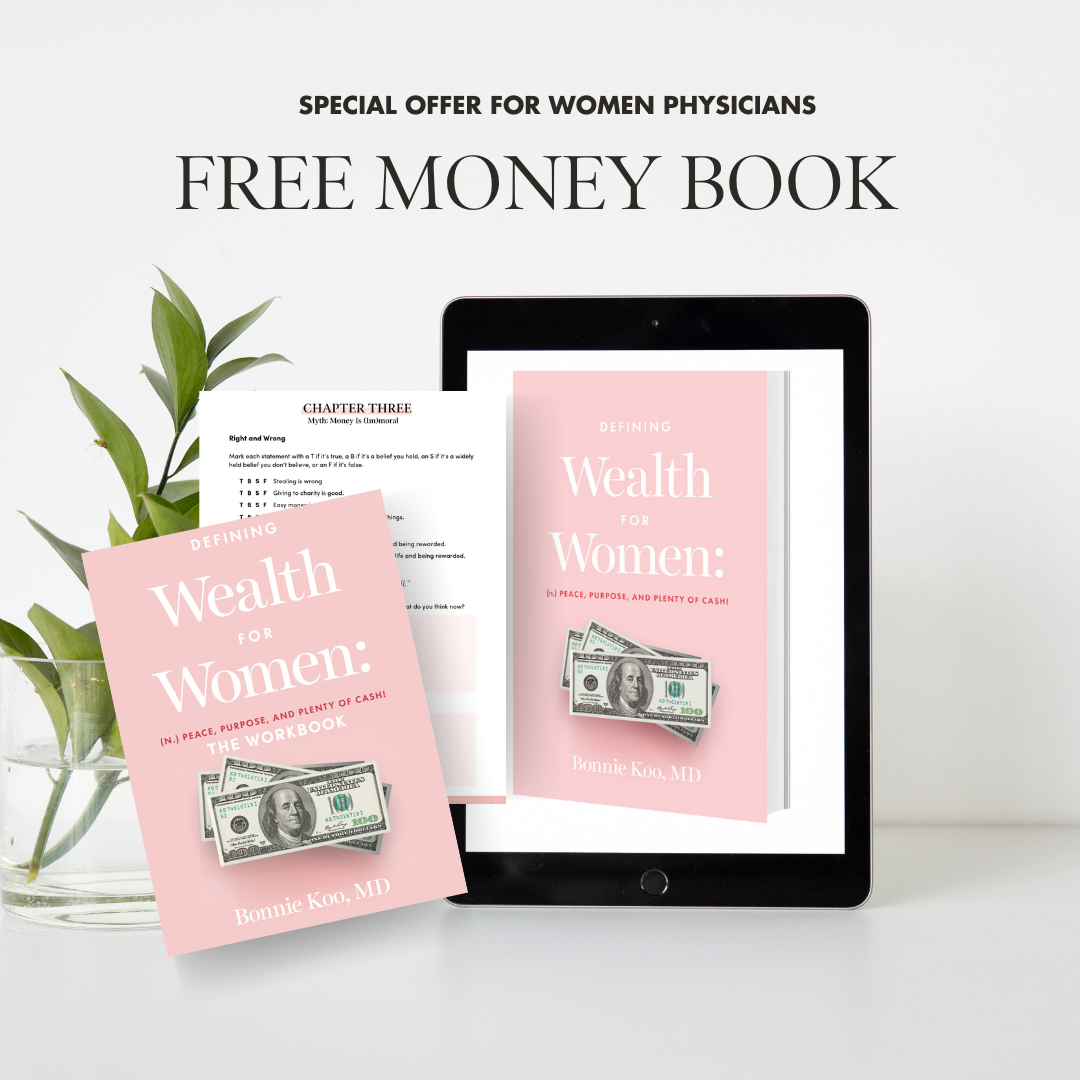
Get started on your journey to wealth by getting my FREE book- Defining Wealth for Women.

What if you could minimize some of the money anxiety in your life and find financial freedom faster? We’ve already discussed ways to process anxiety and how an emergency fund can be a critical part of your financial plan. It’s time to think beyond that financial foundation now.
Part of upleveling your money is about having more freedom and more choice. That’s why thinking beyond your clinical income is key. Let’s explore some of the ways that multiple streams of income can help you be more empowered.
Before exploring the why and the how of multiple incomes streams, it is important to understand exactly what multiple streams of income means. As a physician, most of us have a relatively fixed mindset when we think about income. After spending all that time and all that money in medical school, we tend to think of our income in terms of our profession.
Yet, there are many ways that we can help others, pursue passions, and earn more money beyond our main job. Multiple streams of income are other ways that you generate money. It might be through roles related to your physician brain. For example, many physicians now generate income through telemedicine, moonlighting, locums, surveys, consulting, and even casework for lawyers.
Additional income streams can also come from the stock market and entrepreneurship. The stock market is definitely an important piece of our financial wellbeing. Still, it is important to remember that the real power of the stock market and of compounding require time. That means that for many of us, the stock market will not be a significant stream of income until years or even decades later.

In addition to physician-related work and the stock market, you might explore entrepreneurship. There are many ways that you can create a business online or in person. Start by considering your other interests and talents and work from there.
Now that you know what multiple streams of income means, it’s important to understand why you would want to put in this extra work. Why bother building additional income streams? Ask yourself, “What would happen if my income dried up?” and you will have your answer.
In the past, physicians enjoyed amazing job security. In recent years, how physicians work has shifted. Instead of opening our own practices, many of us find ourselves as employees. There’s nothing wrong with that. However, it is important to note that changes in the healthcare landscape and the recent pandemic have both revealed that physician job security is not what it used to be.
Think beyond your clinical income. Perhaps you want to pursue other opportunities that overlap with your physician skill set, maybe you explore entrepreneurship, or possibly you do both. No matter which stream of income you focus on first, know that you are taking an important step toward being more empowered and upleveling your money and your life.
In this episode, we also explore:
- The benefits of multiple streams of incomes
- They ways physician job security is evolving
- How and why to change your fixed physician mindset
- Other income options as a physician beyond patient care
- My personal experience with multiple streams of income as a physician
- An inside look into how I make money as an entrepreneur
Enjoy the show?
Subscribe to the podcast (on whichever platform you listen on) so you don’t miss an episode! My favorite podcast player is Overcast.
If you love what you’re hearing on the podcast, I would be SO grateful if you left me a review on iTunes. These reviews help other people find this podcast. And you may just hear me read your review on the podcast! To review: click here, then select “Ratings and Reviews” and “Write a Review” and let me know what your favorite part of the podcast is. Thank you!
Featured on the episode:
- Learn more about how to manage your mindset with Wealthy Mom MD

Grab the worksheet to banish your money anxiety now!
Are you feeling anxious about money? Today we talk about how to deal with money anxiety or in other words, how to feel better!
Before we get into it, you need to understand the relationship between our primitive brain and our prefrontal cortex, or higher brain and how feeling anxiety evolved from something that was very useful to our survival but rarely is in our modern day.
For most people, anxiety is not a pleasant feeling and most of us will do anything to avoid it. Be sure to listen to the episode to learn an easy process to manage anxiety and download the FREE worksheet to walk you through it!
If you want to uplevel your money and improve your mindset, you need to understand how anxiety works. Why? Because we all face anxiety and likely always will. However, anxiety does not have to result in paralysis and inaction. Instead, by learning what anxiety is and how to process it, you can move through your anxiety more productively.
Generally, when people feel anxious, they do one of three things: resist it, avoid it, or react to it. In order to truly deal with anxiety, though, we need to choose to fully experience it. By doing so, we can regain control and reflect more accurately on our situation.
One of the most important things to remember about anxiety has to do with mindset. All of our feelings come from thoughts and beliefs. The reason that these beliefs become so powerful is because they feel like the truth to us.
Learning how to turn a more critical eye to the thoughts and beliefs that make us anxious is key.
The four-step process I recommend is to:
- Write down all of your anxieties
- Separate out the facts from thoughts, beliefs, and feelings
- Pick one thought and question it
- Learn to focus on the present
Explore this approach more by downloading my free worksheet and tuning into this episode.
Most of the time, when we are anxious, we are thinking about something that has not happened yet. Anxiety can be so distracting and overwhelming that it keeps us from focusing on the present. While worrying and enduring anxiety can sometimes feel productive, oftentimes it leaves us in a state of inaction. That is why learning to be more present focused, rather than future focused, can be so effective. No one’s life is ever going to be totally free from anxiety. Learning to process it effectively, though, will leave you productive instead of paralyzed.
In this episode, we also explore:
- How the primitive brain doesn’t always fit into the modern world
- What spurs anxiety
- The differences between feelings and beliefs
- A deeper dive into the four-step process to deal with anxiety
- My personal experience with processing anxiety with job loss during the pandemic
- Effective strategies for focusing on the present
Enjoy the show?
Subscribe to the podcast (on whichever platform you listen on) so you don’t miss an episode! My favorite podcast player is Overcast.
If you love what you’re hearing on the podcast, I would be SO grateful if you left me a review on iTunes. These reviews help other people find this podcast. And you may just hear me read your review on the podcast! To review: click here, then select “Ratings and Reviews” and “Write a Review” and let me know what your favorite part of the podcast is. Thank you!
Featured on the episode:
- How to deal with money anxiety worksheet
- Learn more about how to manage your mindset with Wealthy Mom MD

Grab my free worksheet to create your emergency fund plan!
Do you have an emergency fund? Why or why not? And, can emergency funds actually be sexy? In this episode, I discuss why everyone should have one and how the definition of what it actually is can vary widely.
Follow along with my FREE worksheet on creating your emergency fund plan!
As a listener, I hope your goal is to uplevel your money and your life. How do we start to do that? One of the best ways to become more empowered financially is to have an emergency fund.
While an emergency fund might not be the flashiest part of your finances, when you need one, it is everything. In fact, when a financial crisis, like the COVID-19 pandemic, strikes unexpectedly, it is painfully clear how important that safety net is. So let’s take some time to explore what an emergency fund is and how you might fund yours.
The biggest consideration when it comes to emergency funds is that the money is designated for something that is truly an unexpected emergency. When it comes to finances, a loss of income or reduction of income is probably the thing that is most likely to catch people off guard.
Some people also include home and car repairs and medical emergencies in their emergency fund planning. However, it is important to ask yourself if there are certain things that you can anticipate and plan for. For instance, as a car owner, you know that you are responsible for oil changes, tire rotations, and other maintenance. The same is true for homeownership. That is why it is important to turn a critical eye to your finances to see how you can prepare for some of these costs separate from your emergency fund. It is also why making sure that you have the right health and life insurance is invaluable.
When it comes to creating an emergency fund, I teach a four-step approach.
- Define it
- Calculate your needs
- Determine where it will be
- Create your plan
Explore this approach more by downloading my free worksheet and tuning into this episode.
Depending on where you are in your financial journey, you may already have an emergency fund, you may need to refill it, or you may be in the process of creating it. One of the most important things to remember about personal finance is that it is personal. That means that you want to create an emergency fund that empowers you based on your situation. You won’t regret building this safety net into your financial plans.
In this episode, we explore:
- Why you need an emergency fund and what you should actually use it for
- The difference between lean and fat emergency fund numbers
- Common and alternative ways to store your emergency fund, so that it is there when you need it
- A deeper dive into the four-step process you should use to start your emergency fund
- How I created my emergency fund and how it has evolved over time
- Other sources of cash that you can draw from in emergencies
Enjoy the show?
Subscribe to the podcast (on whichever platform you listen on) so you don’t miss an episode! My favorite podcast player is Overcast.
If you love what you’re hearing on the podcast, I would be SO grateful if you left me a review on iTunes. These reviews help other people find this podcast. And you may just hear me read your review on the podcast! To review: click here, then select “Ratings and Reviews” and “Write a Review” and let me know what your favorite part of the podcast is. Thank you!
Featured on the episode:
- Worksheet: Emergency Fund Worksheet
- Blog: Rethinking Emergency Funds
- Learn more about how to manage your mindset with Wealthy Mom MD

Welcome to the podcast! I’m so thrilled you’re here with me on this journey.
I’m kicking off this podcast with an introduction to your mindset. It’s the one thing we have complete control over. In this episode I go over what a mindset is and how your thoughts and feelings affect your behavior.
What is a mindset? Simply put, it is the lens through which you view your life. Some of you already think of yourselves as positive people, while others might see themselves as realists or even pessimists. No matter how you categorize yourself, you probably view your mindset as part of who you are. If that’s the case, that means you think you have a fixed mindset.
The reality is that we all choose our mindsets. Of course, if we aren’t being deliberate and intentional with our choices, we might not even notice that we are making choices at all.
Truthfully, you can change your mindset and I can help you learn how to make that change. That means that you no longer have to wait for the perfect circumstances to feel a certain way about life. You can regain control of your thoughts and emotions to see different outcomes. Different outcomes mean a different life. That’s the power of choosing your mindset.
Before we can begin changing our mindset, we have to understand our current lens. Take some time over the next few days to observe your thoughts and emotions. As you become a watcher of your own thoughts, resist the urge to judge. Simply notice. If you observe any negative thoughts or emotions, write them down. Becoming more in tune with your present mindset is the first step to creating a mindset that will help you uplevel your money and your life.
In this episode, we explore:
- How your fixed mindset is impacting your emotions, your thoughts, and your beliefs
- What it means to choose a new mindset that transforms you from powerless to empowered
- The power of becoming a watcher of your own thoughts
- The first step in transforming your mindset to level up your life
Enjoy the show?
Subscribe to the podcast (on whichever platform you listen on) so you don’t miss an episode! My favorite podcast player is Overcast.
If you love what you’re hearing on the podcast, I would be SO grateful if you left me a review on iTunes. These reviews help other people find this podcast. And you may just hear me read your review on the podcast! To review: click here, then select “Ratings and Reviews” and “Write a Review” and let me know what your favorite part of the podcast is. Thank you!
Featured on the episode:
- Blog: Creating a Wealthy Mindset
- Learn more about how to manage your mindset with Wealthy Mom MD
Other ways to enjoy this episode:
- Transcript
Get started on your journey to wealth by getting my FREE book- Defining Wealth for Women.

Disclosure: Please note that some of the links below are affiliate links. This means that I may receive a commission if you purchase through one of my links. I highly recommend all of the products & services because they are companies that I have found to be helpful and trustworthy. I use many of these products & services myself.
Did you know that you can invest in other things besides stocks and index funds inside of your retirement accounts? How about gold or real estate? These alternative types of investments can be inside tax-sheltered accounts such as your Roth IRA or even solo-401(k). For this post, we will focus on self-directed 401(k)s, but similar principles apply to any other self-directed retirement account.
They are called self-directed because you direct the investments. You open a self-directed account at a custodian that allows them. These custodians are not companies like Vanguard or Fidelity. There is a long list of possible custodians, and I will discuss the one I went with.
Why should you consider opening a self directed 401(k)?
Since the Jobs Act of 2012, real estate syndications and crowdfunding are becoming popular investments. They offer the diversification of real estate without the hassle of direct ownership.
They come in two major flavors: equity and debt investments. Equity investments are where you own a share of the investment along with other investors. You reap the benefits of appreciation.
Conversely, with a debt investment or debt fund, you are loaning money so that other people can buy real estate. Returns vary but can typically range from 8% and up. However, these returns are taxed at your marginal tax rates unless you invest in a tax-sheltered account. This is a perfect scenario for opening a SD-401(k).
You can invest in actual properties inside SD-401(k)s, but for the most part, it is generally not recommended since directly owned properties have very favorable tax treatment.
So which custodians should you consider? There are dozens of self-directed custodians. Through my research I discovered a very unique product that I ultimately decided to go with.

Introducing the eQRP
The eQRP is a customized retirement program that gives you the freedom to invest in alternative investments such as real estate (direct properties, syndications, debt funds), precious metals, notes, oil & gas, including being a hard money lender.
Two things that are totally unique to the eQRP is ERISA protection and checkbook control. ERISA stands for the Employee Retirement Income Security Act of 1974. In short, it ensures certain protections to the account including from creditors. A regular solo-401(k) is not ERISA protected!
Checkbook control means exactly how it sounds–you can write a check from your eQRP account to purchase assets (or more likely via direct wire or ACH transfer). With an eQRP there is no middle man, you are in total control of your account.
It was very easy to set-up. So far, I have invested in a syndication deal with Alpha Investing, who I currently invest in for real estate syndications. M opened an eQRP as well and we plan to use his to start purchasing rental properties.
To find out more about eQRP and if it's right for you, click here to find out more.
Let me know if you currently have and love your self-directed custodian!

This page will be updated as information changes. Please let us know if you find any errors and we will update this page.
[ Disclosures: Please note that some of the links below are affiliate links. This means that I may receive a commission if you purchase through one of my links. I highly recommend all of the products & services because they are companies that I have found to be helpful and trustworthy. I use many of these products & services myself. ]
During these unprecedented times, there are several temporary changes that can affect you financially. In addition, the pandemic has highlighted for many of you the importance of being adequately insured and to make sure your estate plans are in place. We can never know when we will pass, but we do know it will happen at some point. The best time to do estate planning is now.
General
Breaking: Coronavirus Aid, Relief, and Economic Security Act, or the CARES Act was signed into law on 3/27/2020
Highlights:
- Ability to withdraw up to $100,000 from IRAs before age 59.5 without penalty and tax-free IF you re-contribute it within 3 years. If you do not pay it back within 3 years you will owe income taxes only and no 10% penalty.
- Ability to take up to $100K loan from your 401(k), previous limit was $50K. It looks like you can defer repayments until 2021.
- Suspension of RMDs (Required Minimum Distributions) for 2020
- Student Loan relief for federal loans (see below)
- Cash checks for qualifying individuals/families (most attending physicians will not qualify based on income). This phases out between $75,000 and $99,000 ($150,000 and $198,000 married) in adjusted gross income.
- Increased unemployment benefits, including self-employed & contractors
Taxes
Now updated to include CARES Act that passed on 3/27/2020
The federal deadline for filing, making estimated payments, and extension payments is now 7/15/20 (from 4/15/20).
$300 above the line deduction for charity, even if you not itemize. This is for 2020 only.
Roth IRA contributions are also extended until 7/15/20. It also looks like this includes HSA contributions.
There are other provisions that are unlikely to affect most of my readers (real estate investor benefits, etc).
States are slowly deciding if they will extend their deadline or not, so be sure to check in with your respective state(s).
Insurances
Life Insurance
No changes for obtaining term life insurance except that some companies are waiving some or all of the physical exam and laboratory requirements depending on your application.
I’ve gotten questions from readers about whether the pandemic will affect term life insurance payouts. The answer is probably not. This is due to two major factors – the majority of the deaths will be older adults who no longer carry term life insurance and because most people are not insured.
Disability Insurance
Principal is currently waiving physical and laboratory exams for policies up to $10,000 (attendings only).
Guardian is also waiving physical and laboratory exams for those age 45 and younger.
Regardless, if you’re reading this and do not have your own-occupation disability policy, now is the time to obtain it. Here is a primer on disability insurance.
My recommended agents are:
Lawrence Keller of Physician Financial Services – (516) 677-6211
And
Stephanie Pearson, MD of Pearson Ravitz – (610) 658-3251
Estate Planning
Estate planning is top of mind for many folks. Here are some resources to guide you:
In Case of Emergency binder is 40% off right now.
What is this? Would your spouse and loved ones know what to do when you pass? Do they know how to access your accounts and other important documents? That’s why you need a legacy binder. Death planning is, unfortunately, the high priority item that rarely gets done before your loved ones need it. It’s probably due to a combination of thinking you will have plenty of time to get to it and avoiding thinking about your demise.
Here is a blog post on the basics of estate planning.
I’ve partnered with Anderson Advisors for estate planning, specifically with creating a living trust. As a special bonus to my readers you will get free unlimited amendments to your trust.
Student Loans
Certain federal loans will have some reprieve, specifically:
- Direct Student Loans (Direct Stafford Subsidized, Direct Stafford Unsubsidized, Direct Grad PLUS, Direct Parent PLUS, Federally Held FFEL, Federally Held Perkins)
- FFEL if federally held
- Perkins Loans if federally held
- 6 months suspension of loan payments and NO interest through September 30, 2020
- These 6 months still count towards PSLF and other Income Driven Forgiveness programs
If you're pursuing PSLF – basically do nothing, payments will automatically stop (supposedly). If you're not but still have federal loans that qualify…then sit tight and DO NOT refinance privately…take advantage of 0% interest! This is a good source of extra cash right now.
No reprieve for those with private loans but rates are low now, so if it's been a while since you refinances, it's not a bad idea to see if you can get a lower rate. Get an additional 0.25% off when you refinance with SoFi and check out the other bonuses I have negotiated for you here.
On March 20, 2020, it was announced that student loan payments (for certain federal loans only) can be suspended for 60 days. You must contact your student loan servicer to put your loans into a 60-day forbearance with no payments as this is not done automatically.
Interest on federal loans are waived for 60 days as well.
There is no change for privately held student loans (most refinanced loans). However, with all loans you can apply for forbearance if you need to.
In proposal: The Student Debt Relief Act, would cancel $30,000 in student debt for borrowers. The forgiveness would also be tax-free, meaning it would not be taxed as income. For those who owe more than $30,000, the government would assume their monthly payments. Additionally, all efforts by the Department of Education to collect debts would be suspended.
Mortgage Refinancing
Rates are not going down and many lenders are experiencing bottle-necks due to increased demand and COVID-19.
It’s not a bad idea to take out a HELOC if you’re qualified, to have cash on hand.
Small Businesses
Here is a resource for those of you with small businesses (private practices included) detailing the recent changes to help you: https://gusto.com/blog/business-finance/coronavirus-relief-resources
Please contact me if anything is incorrect or if I should add anything to this page.



Welcome to another installment of Interviews with Real Female Physicians. The goal of this series is to share their story so that you, the reader, may learn and be inspired by their experiences – good and bad. We all come from different backgrounds and have different situations. Some of you are married, some are not, some with kids, some with blended families. Let’s show other women that any of these can work financially!
Tell us about yourself:
Hey there! My name is M and I blog over at Reflections of a Millennial Doctor. I am a happily married 32-year-old DINK (dual income, no kids) working as a Primary Care Internal Medicine-Pediatrics (aka Med-Peds) doctor in the Pacific Northwest, somewhere between Seattle and California’s insane costs of living.
I grew up in Toronto, Canada to Filipino immigrant parents and moved to the Midwest in high school, where I stayed for university, med school and residency. Upon completion of training, I moved out the Pacific Northwest for my first real doctor job, but really it was in chase of mountains, dark craft beer and coffee.
It’s funny how one’s perspective changes over the course of the year – on my blog I write ad nauseum about my journey with burnout and disenchantment with medicine. However, I am to the point now where I’ve realized I still love medicine. I love the puzzle of it, the lifelong learning, the privilege of being able to provide reassurance in people’s darkest moments. What I hate is the business of medicine, the machine it has become.
With that being said – would I choose my specialty again? Yes, I love Med-Peds. If I had it in me to go further, I probably would have done Pediatric Hematology-Oncology and perhaps focused on adult survivorship of childhood cancers, so it would still be within the Med-Peds realm.
If there was just one piece of advice I could give to med students, it would be this: Remember you’re eventually going to return to your life once you’re done with med school and residency training. Make sure you take the time to cultivate that part of you so you actually have something to return to – medicine will happily take everything you have to give if you let it.
Did you graduate with student loans?
I didn’t have loans from undergrad due to scholarships and the generosity of my parents, however, I financed my entire med school education with student loans, graduating with $217,000 at 6.8% interest.
I went to in-state public universities for both undergrad and med school. I also lived at home for all of pre-med and my 2nd and 3rd years of med school, so I consider these as giving myself my own scholarships!

How fast (or not) are you paying them off and how are you paying them off?
I started paying on my student loans in residency – at that time we were putting down $1,500/month and it still didn’t touch the principal! By the time I was done with residency, despite the money we had been putting toward the loans, it had ballooned up to $250,000.
In December after I first started my attending job and replenished our emergency fund, I got serious about paying down my student loans. I didn’t want to be beholden to PSLF in case it went away before my loans were done, and I knew I could pay these off within 5 years.
I researched all of the student loan refinancing options out there and settled on Earnest as it gave me the lowest interest rate at 5% and allowed me to make bi-weekly payments of $2,500. Plus, you can refinance every 6 months, thus I’ve refinanced twice since then:
- Once I hit below $200,000, fixed interest rate lowered to 3.38%
- Once I hit below $140,000, I decided to do a variable loan and got the % down to 2.72% which has since gone up to 2.97%
I am currently debating whether or not I should refinance again back to a fixed APR since interest rates will continue to rise, but I may just use this as more incentive to pay off the last $96,000 sooner.
All in all, I plan on being done with my student loans one year sooner than my initial goal of 5 years.
Financial aspects of kids
We don’t have children, but my husband and I have talked extensively about what we would do if we chose to have kids. My husband would likely quit his job and be a stay at home parent. I would also likely cut back for a time. Being free of my student loans will allow me to do this – another great reason to pay them off sooner.
We are strong believers in public school as we both are products of that system and it’s served us well. Public university is still expensive though, so we’d definitely want to start up 529s.
Financial aspects of marriage
I’m married to J who I’ve been with for almost 15 years – nearly half our lives together which is mind-boggling to think about! We did not get a pre-nup, and quite honestly, it never came up prior to our wedding 8 years ago. It may be naive to think we’d split amicably enough, but I’ve never regretted not having a pre-nuptial agreement.
J and I both remember working minimum wage jobs while we were teens and scouring the $1.97 clearance racks at Old Navy looking for deals on date nights at the mall – we’ve moved a little beyond that now, but not by much. Since we’ve essentially grown into adulthood with each other, we’ve adopted the same minimalist mindset and financial practices. Any purchase above $100 other than groceries merits a discussion, and we (usually just me) hem and haw about things for several months before we (I) commit.
Though I am the breadwinner now, all through med school and residency J filled that role. I can honestly say it hasn’t changed anything in our relationship. Unfortunately, we’ve seen relationships have power dynamics shifts in the home based on money, and that’s not something we’d ever want to emulate. We are of the mindset that if we’re both aiming to improve our home lives then our contributions are equally valued, whether they’re monetary in nature or acts of service.
Financial mistakes:
What financial mistakes have you made?
My biggest financial mistake by far was moving from the Midwest to the West Coast. For comparison, just before residency, we were able to buy a little house for $112,000, albeit at the lowest point of the housing market crash – absolutely unheard of when looking at housing on either coast! If I had stayed in the Midwest, I absolutely would have been done paying off my student loans by now and would probably be able to retire by the time I’m 40.
Do I regret it? Absolutely not.
Moving out to the Pacific Northwest has been like walking into an enchanted forest with mountains and fuzzy trees. I’ve discovered a love of the outdoors I didn’t know I had and reclaimed a passion for photography I thought I’d lost (which I’m documenting on Instagram as a wannabe photographer). I’m 100% the fittest I’ve ever been from all the hiking and running I’ve done out here PLUS I have all the craft beer I could ever want at my disposal.
Maybe this is the millennial in me talking, but if this is the fee I have to pay for #livingmybestlife, so be it.

General Finances
What’s your FI (financial independence) number?
This has been a fluctuating number for me – initially, I had told The Physician Philosopher $4 million, but after looking at it from the lens of pure FI vs our retirement number, I have adjusted my projected FI number to $2 million. This is based on anticipating yearly spending at $80,00 which is quite generous and much more than we’re living on currently, but we anticipate increasing our travel, food/dining budget and possibly throwing in a small human in there.
Assuming I would shuttle the $65,000 I’m putting toward student loans directly into retirement funds after the loans are paid off, I should hit my FI number in less than 10 years. At that point, I would definitely cut back on work.
I would be more comfortable with $3 million for retirement and would likely work until I get to that number.
Who handles the finances in your relationship? Do you DIY or do you have a financial advisor?
I definitely take the more active role in handling finances, but as stated above, pretty much all financial decisions above $100 are discussed. We currently DIY though I do use Wealthfront (a roboadvisor) for my rolled over 401k, Roth IRA and taxable account.
What is your net worth?
Our net worth is $350,000+. This is definitely augmented by our home equity – we bought a foreclosure in the Pacific Northwest which has increased in market value over the last 3 years.
How are you saving for FI/retirement?
As a rule, I’ve maxed out all my tax-deferrable investments. I am using my work’s 401k which is a Vanguard Target Retirement Fund. All of my past 403b’s and 401k’s have been rolled into a Rollover IRA, and past Roth IRAs have been rolled into Wealthfront as well. With Wealthfront, you can max out your risk tolerance settings and the portfolio’s target allocation is adjusted accordingly (stocks > bonds). The majority of the investments are in Vanguard and iShares ETFs/stocks. This is automatically rebalanced when Wealthfront invests the dividends and new automatically transferred funds.
I also have an HSA which I have been maxing out for several years as well and am investing via Lively HSA (which has no minimum requirement before you can invest) via TD Ameritrade, which offers commission-free ETF’s. I manually try to rebalance every time I invest the new funds.
I will be moving into a new job next year that will also open up a private 457b option, which I fully plan on maxing out.
Once my student loans are paid off, I’ll have to figure out where that money will go – likely will be a taxable account.
Biggest financial failure/regret:
I quite honestly don’t have one. I am so incredibly grateful to have had good intentional financial habits from early on. I credit my father for this, as well as having had a job since I was 13. I knew the value of a hard-earned dollar and just how quickly that could disappear on just one item.

Do you have insurance?
I have own-occupation disability insurance but no life insurance or umbrella. The lack of umbrella insurance is such an oversight on my end, and one I will have to remedy ASAP. As for life insurance, we really haven’t felt the need to get that now as my loans would be discharged upon my untimely death, and my husband can support himself. This will need to be addressed in the future.
Do you give to charity?
I volunteer at a free clinic, donate to a couple of charities close to my heart (The Potocki-Lupski Syndrome Foundation and The International Rescue Committee) and always max out my employer’s matched contributions to charity.
This year, in honour of a close friend of mine who was diagnosed with stage 4 colon cancer at the young age of 34, I’ve donated to PALTOWN which oversees Colontown, an amazing group that focuses on patient empowerment and education. I am also currently helping support a cousin of mine through university, so between all of that, it comes up to a tidy sum.
Any parting words of wisdom?
Financial independence is great and all, but sometimes the pursuit of FI distracts from what is most important: a life well-lived.
I often think of Bronnie Ware’s 5 Top Regrets of the Dying:
- I wish I’d had the courage to live a life true to myself, not the life others expected of me.
- I wish I hadn’t worked so hard.
- I wish I’d had the courage to express my feelings.
- I wish I had stayed in touch with my friends.
- I wish that I had let myself be happier.
All the money in the world won’t shield us from these regrets. It is up to us to continue living intentionally and with connection – to ourselves and to others.
Tell readers a fun/random fact about you:
In a past life, my side gig was to play the piano at wedding ceremonies and receptions. I’ve always fantasized about having a baby grand piano, but alas, that would never fit in the tiny house of my dreams.
And finally, where can people connect with you?
I’m apparently everywhere on the internet!
Blog: Reflections of a Millennial Doctor
Instagram: Millennial Doctor – This is definitely where I’m the most active and post daily pictures of my photography and hiking adventures.
Twitter: @Millennial_Doc
Facebook: Reflections of a Millennial Doctor
E-mail: [email protected]
Get started on your journey to wealth by getting my FREE book- Defining Wealth for Women.